At a Teach for America fundraiser, DFER politician and then Colorado Senator, Mike Johnston, tells a story that will be brief because (he jokes) he doesn’t want to keep his audience from dessert. He launches into a narrative about a scrappy, young, founding principal who beat all the odds because he believed in truth and hope. Johnston’s story is peppered with the names of students and their stories. Over the course of 21:53 minutes, we meet Tasha, Flavio, Jermaine and Travis (the 44th kid). He weaves from story to story and then back to how he and others (mostly TFA alums) fight against a system that has been catering to “an old set of interests with a wrong set of priorities,” and he ends by telling an eager, young audience that they are the army who, through sheer force of will “…would hoist America onto its shoulders and carry it across the water…”
What Johnston is saying at that moment (without a shred of irony) is that what America needs most is to be saved by an army of over-privileged youth right out of selective college who will move, with all deliberate speed, into positions of influence and power and more privilege. To return to the 2010 ed reform documentary, they are the Supermen that America has been waiting for, and they will, through sheer force of will (and a rehabilitated mid 20th century vernacular), fix all the things. The message is classic trickle down theory:
More privilege for the over-privileged helps the underprivileged.
The first story of his narrative is about the first day in his new school, The Mapleton Expeditionary School of the Arts (MESA). On that day, Johnston takes all his new 9th and 10th graders up to a football field, puts them in a circle, and tells them why he’s there. He says,
“What we know right now is if we look at the data from this neighborhood… what we should do is take half of this circle right now and send you home because what we know is the data tells us half of you will never graduate from high school. We could do that… (pause) We’re here because we believe that something dramatically different is possible… if you are willing to come in here and give this your best every day… not only will you graduate from high school, you’ll graduate with admission to a four year college in your hand and with money in your pocket to pay for that degree.“
The audience claps, but the kids didn’t believe. Their parents didn’t believe. His superintendent “didn’t believe, as well.” (smirk at 2:14) No one believed… But, he did it.
Only he didn’t.
And here is where Johnston’s embedded disclaimer does it’s job. He’s not going to get caught on the fine point. He freely admits that he’s had more failures than successes. In fact, he’d tell that much longer story (if dessert wasn’t waiting) because “…it is not at all a silver bullet story…” (7:13)
But, it is a kind of bullet.
At this moment, you might think that this is a story about Mike Johnston. It isn’t. Johnston is just one name put to one story. You might call him Travis (the 44th kid) of ed reform. He is not unique. His story is typical of young, privileged, socially committed soldiers conscripted to a wrong set of interests and a wrong set of priorities. This is a story about the 45th kid.
Facing the Harsh Truth
Toward end of his speech, Johnston asks his audience to face the harsh truth. Here’s a harsh truth. In order for Johnston’s school to become the first public school in Colorado history to graduate 100 percent of its seniors with acceptances to four year colleges… 40 percent of his juniors had to leave without a HS diploma. What dessert interrupted was that Johnston’s success came at a high price that was paid by others.
This isn’t to say that Johnston didn’t do some good during his short tenure as principal. He did. If you add back the 40% of juniors who disappeared from the senior roll, Johnston shepherded in a modest, but commendable 10% increase in the graduation rate for his group.
However, modest improvements don’t sell privatization, unfair labor practice and fast track careerism… all goals in the private interest that are sold alongside the goals of the public interest. Ed Reform makes serving a private interest virtually indistinguishable from serving the public one. It becomes easiest for a rising star to make the pragmatic, commonplace choice to accept whatever half truth or lie of omission keeps the train running. So, 40% of juniors have got to go. But, this article is not about Johnston. It is about other stakeholders: the 45th kids, the families that love them, and the teachers that teach them. And, it asks one question about removing a large share of a junior class.
Who is being served?
Reformers steeped in the tea may say, you’re focused on the wrong set of priorities. Focus on the kids who are going to college not on the ones who aren’t. (hmm.) You have a deficit mindset. These incredible young men and women are beating the odds, and all you want to do is stain their success.
Nope. It’s not their stain. Celebrating the personal success of students going off to college does not require celebrating the fake success of a business model. Students going off to college deserve all the accolades, but their interests are not served by the disappearance of 40% of their peers at the end of 11th grade. The only interests that are served by a school’s 100% Forever Mission Accomplished party are the private ones… the career of the rising star, the reputation of a school network, the agenda of the wealthy donors that fund them.
Who is not being served?
In 2008, MESA disappeared 40% of the 11th grade before senior year. They were not served. MESA continues to this day to boast a 100% college acceptance rate among their seniors even though they have a 7% proficiency rate in Math and a 22% proficiency rate in English (as of 2018). Urban Prep (2015) disappeared 60% of their entering 9th grade and 33% of the remaining junior class. They boast 100% Forever. It won’t be difficult to accomplish using their method. Success Academy (2018) disappeared 68% of their entering class. NorthStar (2006) in Newark disappeared 74% of their entering class. Only 26% of their students were served. Similar stories can be found all over the charter networks. Urban Prep (2016) in Chicago, Yes Prep in Houston. Kipp in New York City. Achievement First in New Haven.
Some will rightly say that Public schools fake graduation data, too. They do. They send kids to night schools or alternative schools, and it must be called out with the same vigor. But, let’s be honest. A traditional, locally controlled public high school can’t disappear 74% of their entering 7th grade or 40% of their junior class. That would leave way too large a trail of grumbling parents. Parent oversight, educator agency, school board accountability, and community control makes such a policy of disposal impossible.
It is where there is little oversight and low stakeholder agency, where a disposing institution is aided and abetted by private interests, that a policy of disposal can become widespread. We can and should celebrate each and every one of the kids who graduated from these schools and still rebuke the powerful lies of omission that puts a more successful face on a less successful fact. Here’s why it matters.
A muscular lie detracts from honest achievement.
Faked superior performance in education is analogous to the use of steroids in sports. It normalizes fantasy achievements which make real achievement look paltry by comparison. It’s hope without truth. Whether it’s practiced by charters like Urban Prep, by a small new high school like MESA, or by a neighborhood public high school, steroid success ups the ante and puts the pressure on all schools to report and celebrate misleading results.
It’s bad for kids.
These are not selection schools that don’t take the child who isn’t a high achiever. These aren’t private schools whose parents pay handsomely for the privilege of exclusion. These are taxpayer funded public schools that advertise that they take all kids and yet can, at their discretion, dispose of any and all of them at any point in their school career.
Removing 11th graders so you can say 100% Forever isn’t just bad for the invisible kids who aren’t good for brand. It’s bad for the kids who are. The premise is wrong: It’s the school’s responsibility to be right for the child, not the child’s responsibility to be right for the school. And not the public’s responsibility to choose from a portfolio of potentially all mediocre choices. Further, the acceptable students learn, as their peers quietly disappear one after another, that they are products and only as valuable as they are useful to their brand. Once learned, that’s a lesson that keeps on giving over a lifetime.

It’s bad for parents
Marketing and the use of misleading data requires that all parents be savvy consumers of information. One would think that truth in advertising laws would protect parent consumers from misleading advertising (much like we expect food to list all their ingredients or pesticides to post warning labels); however, networks are free to leave off the full information parents need in order to evaluate a school. Parents are required to find the data and crunch it for themselves in one of the most important choices they will ever make for their child.
Apologists for this practice will drag out the ed reform talking point script. “We trust parents to make the right choice for their child.” and, invariably, they will resort to the implied racism trope (always an ed reform favorite). “We know which parents YOU think can’t make decisions for their own child.” What they won’t do (for all their anti-racist rhetoric) is put truth in advertising before their splashier claims. They don’t list how many of an entering class remains or how many of their juniors they offloaded. The obligation to recognize misleading claims is placed squarely on the backs of the consumer parent.
It’s bad for policy.
Quaker Oats and other oat based cereals recently tested with high levels of glyphosate in parts per billion (ppb). Oats either harm your child or save her depending on whether oats are healthier than the difference between an acceptable level of 160 ppb and an average level of 930 ppb in your child’s body. PepsiCo and General Mills will resist this data. They have products to sell, so they will attempt to influence your choice of product with their hefty marketing budget. You may see one ad after another selling happiness, clean living, well appointed kitchens and Cheerios. You may never even hear about the glyphosate (unless you have a pesky facebook friend), but if it turns out down the road that the extra roundup in your breakfast cereal is a harm, your family will bear the costs of misleading marketing, denial and omission.
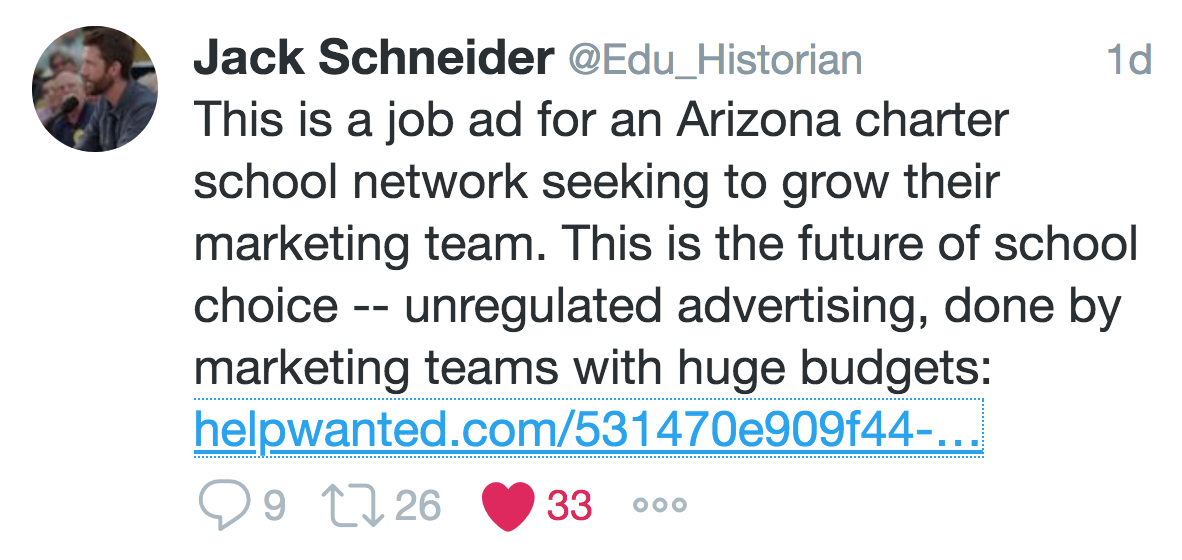
 The fine print on the a la carte portfolio model is that misleading marketing is a predatory but acceptable business practice. The consumer is expected to do their own homework.. even when they aren’t scientists or education industry insiders. Parents are free to believe™. They are free to vote with their feet, but they are not free to resist, regulate or constrain. The onus is on the parent to figure out where the truth is in the claim and pay the consequences of any mistake.
As a result, a disposing school can remove as many students as they wish to fulfill their 100% Forever claim. They can hold onto non-disruptive kids and use their per pupil dollars for years and still not return a high school diploma. They can create a culture of winners (who gets to stay) and losers (who’s got to go). They can use fake data to suggest that superior performance is a result of at-will employment, ending due process, high class size with exceptional teachers, blended learning, daily test prep, low community agency, mayor controlled school systems, two hour bus rides to school, high but unpublished attrition rates. They can dump any educator, any child, any parent who displeases them and effectively dampen protest and oversight. They can maintain a parasitical relationship to living public schools and return only those students who they do not prefer. They can pursue instability with no concern for the people they are supposed to serve.
All of these are the bad policies of more privileged people on the backs of less privileged people… the kids that are removed or taught in test prep factories, the teachers that labor every day under a cloud of undeserved censure, the schools that are shamed by fake data, and the users and benefactors of public education itself. The mission is not only NOT accomplished, it is subverted and harnessed to an entirely different mission serving the oldest set of interests and the wrong set of priorities.