On Being the Change You Want to See

What follows is an open letter to a young teacher, Marilyn Rhames, who wrote for Ed Week in a piece called A Course of My Own about her experience in a hostile school environment with a principal who was vicious to both student and teacher alike. Ms. Rhames’ conclusion about her experience was that a toxic principal happened to the children in her care and not really to her. My conclusions are that it happened to them all.

Dear Ms. Rhames,

It’s a terrible thing to listen to an abusive principal tell elementary school students that aren’t good at basketball that they shouldn’t bother to try out for the team because they can’t help the team win . Being told by that same principal that she likes money and that teachers might, at any time, be fired is equally distressing.  I can imagine why you told all these stories in the faculty room when you were in a better school.  They are cautionary tales and shocking, from one point of view. And, I appreciate your caring for the children who had to learn under this principal’s leadership, but I must disagree with you and with the social studies teacher who piously told you that this all just happened to the children.  It didn’t only “happen to them.”  It also happened to YOU.

It did happen to the children.  For the most part, they probably won’t cry about it in years to come; many of them will probably not even remember it.  But, her actions and her words may directly influence some of those children’s willingness (as children and as adults) to try things or persevere when faced with difficult tasks. That’s a terrible message to give to anyone.

But, you were also given a terrible message.  You were told that you were a disposable tool of your industry, that you should fear for your livelihood  every day that you work.   You were presented with the message that working people in many industries are hearing currently; that is, no matter how hard you work, your ability to feed yourself and your family, to offer a future to your children or to feel secure in the knowledge that good work  will be valued is at risk.  You were told that you may be replaced at any time for any reason.  You got the message that your survival depends on the sacrifice of anything and everything that may be asked of you.  You were told to live and work in fear.

You may say, well the issue of teaching is bigger than us.  It’s bigger than a mortgage or a family or ability to retire one day.  I would disagree.  I think that the underlying message is that work is bigger than anything or anyone, and that message is related directly to all of us, young and old.

You suggest that “[e]ducators and policymakers must boil the chatter down to two essential questions: to what degree will this policy enhance student learning and how will we know?” I  suggest that if you don’t boil the chatter down a little further than that, you’ll be enhancing student learning for a life destroying purpose.  In accepting terms that define you as expendable, in choosing to manage the anxiety of knowing that that no matter what you do, you have reason to be insecure of your livelihood and your ability to feed and provide for your family, you accept a life diminishing notion of every person’s relationship to their work.  You tacitly agree to work with no regard to its impact on your family, yourself or your children.   You agree in quite blatant terms to have no value.  This may be something that sounds like noble sacrifice to you.  But, you might like to consider what you’re selling as well as what you’re teaching.

Of course, it’s important to work hard for children, to do good work with integrity.  It’s important to understand what children are learning.  But,  it is also important to consider what your learning is preparing them for.  Are you readying them for a life of opportunity or for a life of insecurity and fear, of work without end, of a constant and pernicious anxiety about their survival in an inhumane marketplace? Are you readying them to embrace life or to negate themselves and their families in their turn?  What your employer told you was acceptable for you is what you accept for them, and if you accept that this act is somehow too small a concern in a world that needs change, you’re not just agreeing to your own erasure, you’re agreeing to theirs.

Maybe it’s not such a noble act to manage undeserved fear of reprisal or to stuff anxiety over the consequences of  limited ability to negate the impact of poverty on opportunity.  At least, not when you consider it in light of the fact that in accepting those conditions, you prepare children for your own fate.   Perhaps considering the welfare of children as separate from the family or the welfare of families as separate from the people who work to maintain them is a false dichotomy.  Maybe… maybe… when you fight for a living wage, for decent working conditions, for the professional status of your career, for dignity in the performance of your work, you fight for the children you teach, as well.

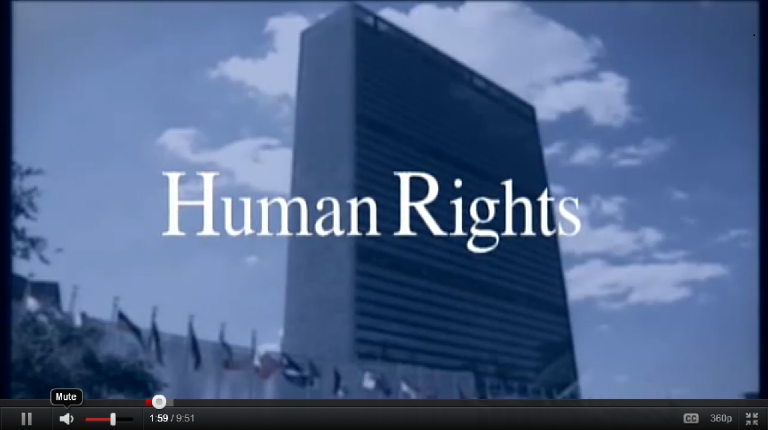
The Universal Declaration of Human Rights as visualized by Seth Brau and another one that depicts a great short history of Human Rights.  Both are worth seeing and are excellent resources for the classroom, as well.


This entry was posted in Educational Reform Movement, philosophy. Bookmark the permalink.

9 Responses to On Being the Change You Want to See

  1. Rona Pavlo says:

    Yes, self-respect is a necessary component of dignity and dignity is what I hope we give to our students.

  2. Damian says:

    Short version: Spot on, Audrey.

    Long version: Of all the issues that the ed “reform” movement has brought, and have been argued, the one that I never really hear discussed too much is the false dichotomy that they present: you are either in it for the kids, or you are out for yourself and don’t care about the kids. I am about to start my 12th year in public education, and if I wasn’t in it for the kids, I would do something else. At the same time, I would like to be able to continue to make my mortgage payments, pay for my own kids’ daycare, be able to spend time with my own family, and perhaps even tuck some money away in savings, both for my kids’ college funds and for general family use. I would like to be paid commensurate to my experience, my education, and the particular skill set I bring to a district (not to mention the fact that I work my ass off; it’s just part of who I am as an employee – it’s as true now as it was when I worked part-time jobs in school).

    I really don’t think that’s too much to ask. To expect teachers (or anyone, as you rightly pointed out) to live for their job at the expense of their personal lives is to create a mythical ideal to which very few teachers will be able to rise without burning out (which, a cynic might suggest, is part of the plan to cycle through young and less expensive teachers).

  3. Sturgeon says:

    Thank you for this intellectual and spiritual response to that benighted, pandering piece. My administrator just sent Ms. Rhame’s piece out to our entire faculty. What a sad and disheartening end of our summer.

  4. bill says:

    Full support. Whenever I hear rhetoric like “to what degree will this policy enhance student learning and how will we know” usually I know I’m listening to someone who thinks data counts more than people, prioritizes students and their parents over teachers instead of considering things fairly and balanced (see the risks you mention above), or simply doesn’t know what policies work and which ones don’t. Kind of scary to hear from admin. who are supposed to know how to run a school. Well this has been my experience anyway.

  5. Saphira says:

    I’d be more impressed with your article (in which you do make several good points) if I’d been able to get this out of my head once I’d read it: “It did happen to the children. For the most part, they probably won’t cry about it in years to come; many of them will probably not even remember it.”

    This comment demonstrates a shocking lack of understanding how distressing situations and events affect children. I was bullied at school as a child and you better believe I remember it 30+ years later. Worse, it’s had deep effects that have taken decades to recognize and to undo. And I am far from the only one who could tell such a story. The only surprise here is that anyone would be so naive as to imagine that kids just brush these things off as if they never happened.

    Writing off incidents like these because “they probably won’t remember it” demonstrates that you were one of the lucky ones that never experienced such a thing. It also makes it frighteningly easy for you to write off what happens to kids in your care because you either don’t know how to handle it or are for some reason unable to. When you’ve been there, you know to reach out to that kid and at the very least let him or her know that you’re there and willing to do what you can to help. The idea that any teacher (I am a teacher, too) would not understand something so basic is as distressing to me as any of the rest of the belittling arguments being batted around in the name of “reform.” In that respect, the social studies teacher is absolutely correct to focus on the distressed child rather than the adult, which is the point you’re clearly missing among all the good ones you’ve made.

    • admin says:

      I appreciate what you are trying to say about formative experience and the need to be mindful of the impact that events can have on children. I must agree that being told that you shouldn’t try a sport if you are not already good enough to bring home the gold can have a terrible impact, as I think I point out.

      The point I am trying to make is that the behind the scenes abuse of personnel is not happening to those kids. Further, teachers are no less entitled to protection from employer abuse than any other employee. Putting the children in the mix is a blatant attempt to muddy the waters and encourage teachers to tolerate abusive conditions as evidence of their commitment to children. We can be committed teachers without giving up our right to humane and respectful treatment in our place of work

      On another note, you realize, don’t you, that you know absolutely nothing about my experience or what kind of teacher I am.

      • Saphira says:

        “The point I am trying to make is that the behind the scenes abuse of personnel is not happening to those kids.”

        Yes, and that is one of the many excellent points you make–and which I acknowledged in my earlier comment–twice! I was merely taking issue with dismissing children’s memories of distressing events, and I believe I made that abundantly clear. Just to be doubly sure this time: I agree with everything you said in the paragraph I just quoted.

        On another note, you realize, don’t you, that you know absolutely nothing about my experience or what kind of teacher I am.

        That’s correct, but it’s fair to infer from your comment that you don’t have firsthand experience with the sort of instances you dismiss, because if you did, you would be far less likely to handwave them so easily. Could I be wrong? Sure. But the fact remains that your dismissal is off base and deserves to be called out as such. And I would only point out that, according to your own statement, we’re on equal footing–you know nothing about my experience, or what sort of teacher I am, either, aside from what little I’ve told you.

        • admin says:

          I don’t think your inference is fair at all. If you reread the paragraph with a little more care, I think you will realize that you were transfixed by sentence 2 and didn’t put that sentence together with the rest of the paragraph.

          It did happen to the children. For the most part, they probably won’t cry about it in years to come; many of them will probably not even remember it. But, her actions and her words may directly influence some of those children’s willingness (as children and as adults) to try things or persevere when faced with difficult tasks. That’s a terrible message to give to anyone.

          I really don’t think you can argue that I am dismissing anyone’s pain from that. The Social Studies teacher stated that it would be the children that would be crying about it in years to come. Factually, many of them will not remember it or think about it. Yet, even among those who do not remember.. EVEN IF they didn’t remember it… it might impact the way they approached challenges in life. One could and should infer that I was saying that the damage goes even deeper than memory.

          You may certainly point out that I know nothing about your experience (other than what you have already disclosed) or what kind of teacher you are. But, then again… I didn’t make any statement regarding them either. Peace.